

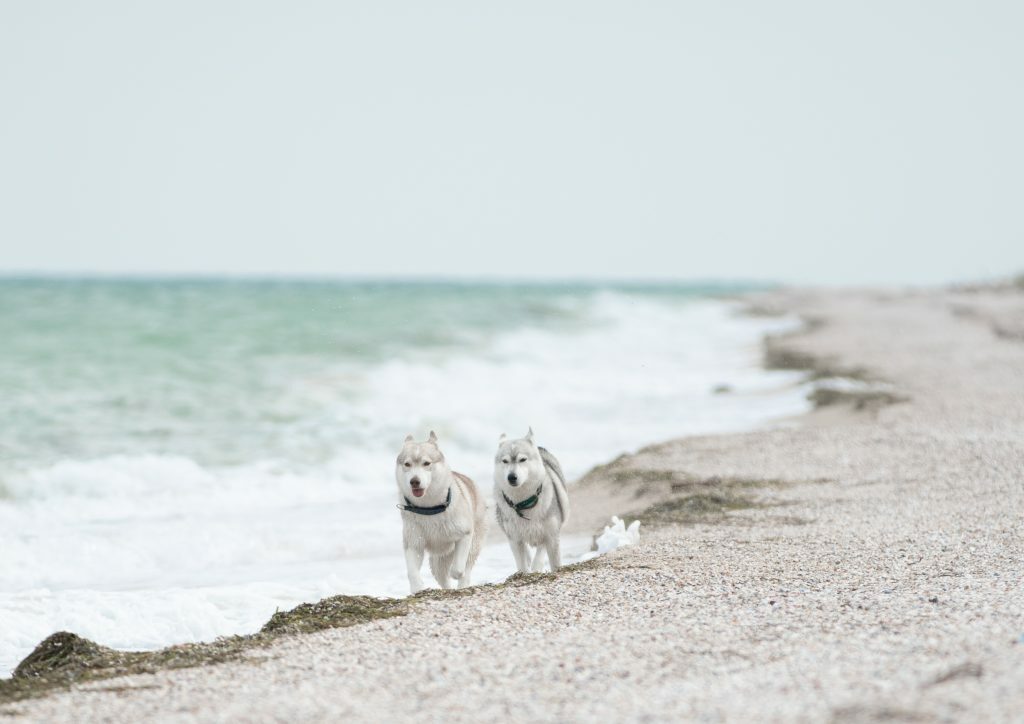
Will my Husky definitely run away from me just because "all Siberians do that"?
The most common fear about Siberian Husky is their reputation as escape artists. It's the number one concern people bring up and the number one reason some never get a Husky. But is it really true that every Husky will bolt the moment it gets a chance?
No. Not all Siberian Huskies escape, and not every Husky will run away from its owner. But to understand why some do you have to understand the breed.
→ Read: The history of the Siberian Husky — and why independence is in their DNA
The Root of the Issue
Siberian Huskies are incredibly intelligent and curious dogs, known for their energy and agility. They love exploring new territories and are enthusiastic about sniffing various scents, just like other breeds.
Are you familiar with the history of Siberian Huskies as a breed? They are northern sled dogs, running without knowing where or why, pulling sleds in blizzards, freezing weather, and poor visibility. Most normal creatures would wait or not venture out in such conditions for self-preservation, but not these dogs. They are meant to be this way; otherwise, the whole purpose of having such dogs among northern tribes would be lost.
That's why independence is a prominent characteristic of Siberians. As working sled dogs, they are required to make independent decisions.
It's crucial to understand that Siberian Huskies are living beings with brains, emotions, intelligence, and expectations. They have personalities. Their behavior within a family is influenced by many factors — the environment they were raised in as puppies, their overall socialization, their relationships with the owner and the family, and the role they play within that family.
→ More about the Siberian Husky temperament and what makes them unique
5 Reasons Why Husky Escapes
1. Breeding Season
A male Husky may run away if he senses a female in season. Females may also escape due to the call of hormones, seeking to mate.
If you own a female Husky, it's essential to keep track of heat cycles. During the entire heat period, walk her on a leash and avoid locking her indoors to "wait it out." Continue regular walks but shorten the duration and increase the frequency.
If you own a male Husky, it's your responsibility to train him to switch his attention in critical situations, making it easy for you to recall him or stop him. Socializing him well including around females in heat is crucial, because nothing distracts a male Husky more than that scent.
2. Absence or Lack of Regular Walks
Regular walks are essential for Huskies to satisfy their needs. The simplest reason is a potty break especially if you live in a house with a backyard. Your Siberian may feel the need to go outside since she considers the yard her home territory. Huskies are very clean and don't like to do their business where they sleep or rest.
Walks also allow Huskies to assess and leave their own marks in response to other dogs' markings their way of exchanging information. They fulfill their curiosity about the surroundings: parks, streets, waterfronts, forests, beaches. This mental stimulation can be quite exhausting, fulfilling their desire for novelty and mental challenge.
By the way, sniffing is a very resource-demanding activity for a Husky's brain as it is for any dog.
The main message: Siberian Huskies are not fluffy beautiful toys you bring home and confine behind four walls or a fence. They have fundamental needs — physical, mental, and resource-related that should be fulfilled.
→ Do Huskies really need 30 km a day? No — here's what they actually need
3. Lack of Proper Relationship and Trust
When a Husky sees its owner as a trustworthy leader and feels confident that the owner or the whole family is their pack, the Husky is unlikely to want to run away in search of another family.
However, if the relationship is built on dominance and lacks trust in the owner's leadership, there is a higher chance that your Husky may try to escape under certain circumstances.
A Husky that considers you family will never run away forever. It might venture quite far — 2-3 km — but it will always come back. Because it has somewhere to come back to.
→ Life with a Husky: how trust and partnership really work
4. Insufficient Training
Lack of proper behavioral training can result in the following issues:
- Not teaching the most important commands: "Come" and "Stay/Stop"
- Failing to train for mental stability in critical situations
- Not desensitizing your Husky to various sharp or prolonged sounds preventing fear-based escapes
- Skipping fundamental socialization during the puppy stage
- Not training your Husky to walk within a 5-6 meter radius without a leash
These aspects of training are crucial for a well-behaved and happy Siberian Husky. And ideally, the foundation starts with the breeder.
→ How we socialize our puppies from day 3 — and why it matters
5. Strong Hunting Instinct
A Husky's prey drive can lead them to escape from your property if you live in a rural area with various wildlife like chickens, rabbits, hares, squirrels. Your Husky may be naturally driven to hunt for its own food, and if they lack physical and mental stimulation, they might seek opportunities on their own.
What You Should Do Is Not What You Shouldn't
I'd like to remind you: the problem of Husky escaping cannot be solved by increasing the height of fences with barbed wire on top, or by locking them tightly in a kennel. In doing so, you're just sweeping the issue under the rug. You're postponing the solution and making it worse.
So what should you do?
Regular walks even if you live in a large suburban house. These walks should be enjoyable for her in terms of interaction with you as a team. Try activities like "following the hand game" or "obstacle course game for both of you." These games simulate the main task of an adult Siberian Husky collective hunting. In the wild, hunting is a team effort, and these games replicate that concept perfectly.
Physical exercise — running in a harness, bikejoring, kick scooter, jogging alongside your Husky, mountain hikes, swimming, cross-country skiing, or attaching them to a sled. Taking your Husky on vacations or long trips provides excellent stimulation.
Mental stimulation: searching games, enrichment tasks, group socialization clasess, handling classes.
Maintaining trust and family bonds providing protection when needed, responding to your furry friend's requests, sharing meals and sleeping areas, granting access to safe spaces, engaging in shared activities.
→ Read: 8 secrets of good Siberian Husky behavior
The Bottom Line
A Husky doesn't run away because "that's what Huskies do." A Husky runs away because its needs aren't being met or because it doesn't trust your decisions enough to stay.
Build trust in your decisions. Be a Lifelong Leader for Husky. Provide structure. Meet their needs. And your Husky won't need to look for a better life somewhere else, because it already has one with you.
All of the above can be summarized in one phrase: to love your Siberian Husky is to live truly with your Siberian Husky.
— Tetiana Karpenko, Hakuna Vota Siberians
_________
Concerned about escaping — or any other Husky myth?
→ 7 Husky myths debunked | Why people choose Huskies | Meet our dogs
Prev Post How are Siberian Huskies in hot weather?


