+380-63-359-74-69 79000 LVIV, UKRAINE


The Siberian Husky Standard: What a Purebred Siberian Husky Looks Like
Home » Breed standard
Siberian Husky standard - what to know
The breed standard is a description of what purebred Siberian Husky should be like. Each section of the standard describes the Husky’s body and appearance in accordance with its function: to be a northern sled dog capable to run long distances and pulling light loads in the harsh Arctic climate. The standard also specifies which coat and eye colors are permitted, what the body structure should be, and which defects are considered disqualifying.
For a prospective owner, knowing the breed standard is key to making a safe choice. The internet is flooded with ads for “Husky puppies” featuring photos of dogs that only vaguely resemble husky. By knowing the breed standards, you won’t buy a mixed-breed dog passed off as a purebred siberian husky, and you won’t fall for a “rare or trendy coat color” that doesn’t exist in this breed, or a “unique eye color” that sellers use to charge an inflated price. You won’t pay top dollar for a puppy with defects as if it were a high-quality puppy.
The breed standard is a breeder’s “bible”, it’s their go-to guide. And we’re no exception. If you’re choosing a puppy, the standard will help you identify a dog with good proportions. If you already have a Husky, you’ll better understand why your dog moves, behaves, and looks the way it does. Behind every word in the standard lies the thousands of years history of a breed bred to help people survive in the severe conditions of the Arctic climate
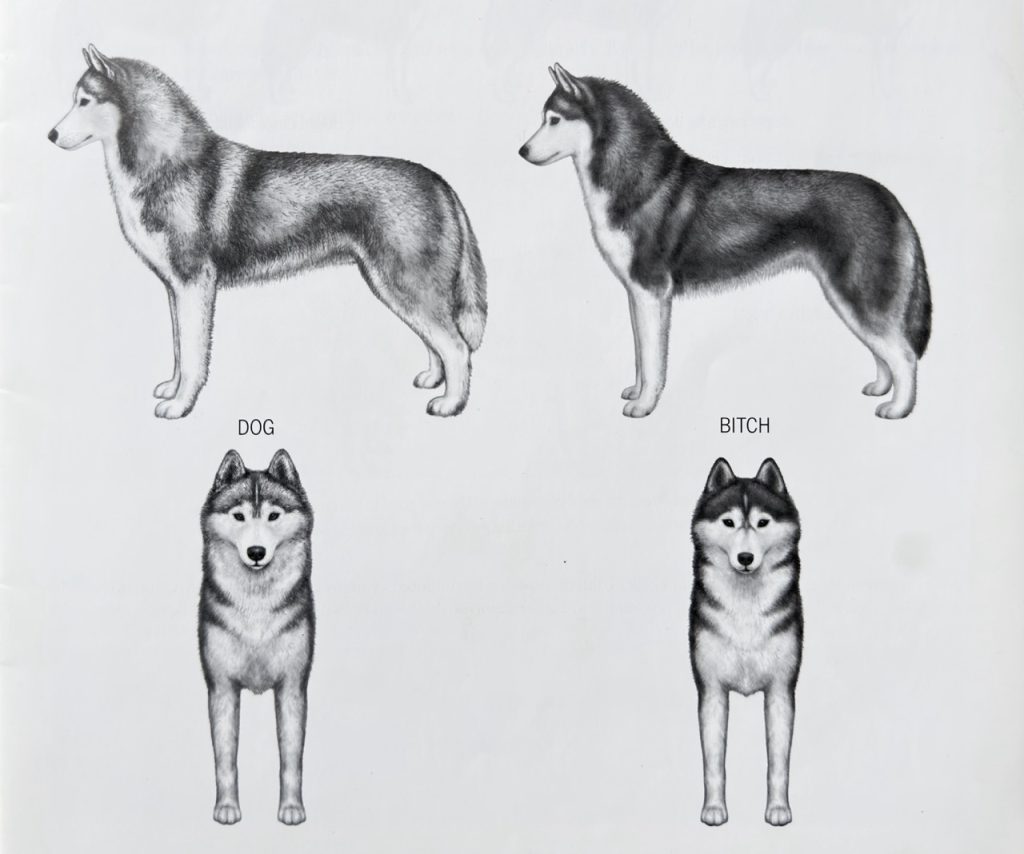
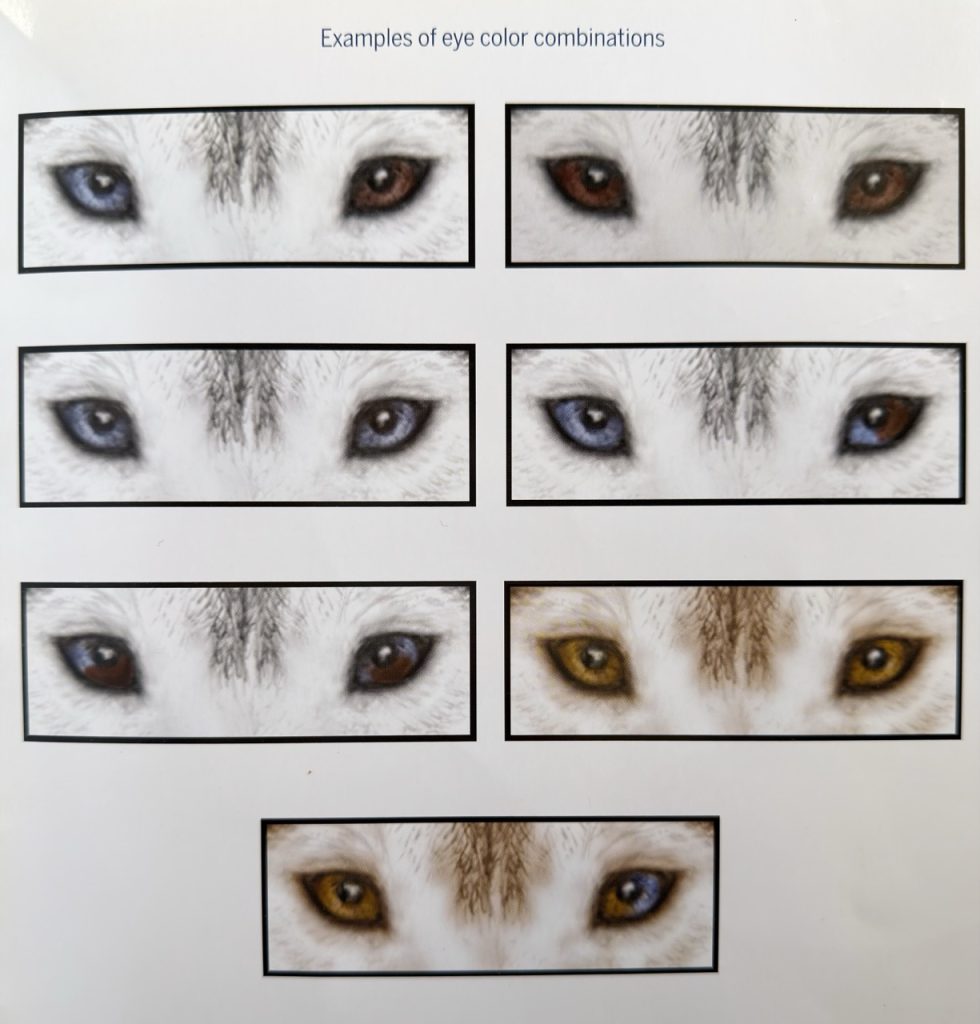
ORIGIN: United States
DATE OF PUBLICATION OF THE OFFICIAL CURRENT STANDARD: November 14, 2022.
UTILIZATION: Sled dog.
FCI CLASSIFICATION: Group 5. – Spitz and primitive types.
Section 1. – Nordic Sled Dogs. No working trials
General Appearance of Siberian husky
The Siberian Husky is a medium-sized working dog breed, fast and light on its feet, moving freely and gracefully. Its body is moderately compact with a thick coat, erect ears, and a bushy tail, all of which point to its northern origins. Its characteristic gait is smooth and appears effortless. This breed excels when harnessed to a sled, skillfully pulling light loads at a moderate speed over long distances. Its proportions and body shape demonstrate an ideal balance of strength, speed, and endurance. Siberian Husky males are masculine but never coarse or bulky; females appear elegant, feminine, and without any weakness in their body assembly. The Siberian Husky is free of excess weight when in optimal physical condition, possessing firm, well-developed musculature.
important proportions
Viewed from the side, the body length from the shoulder joint to the rear point of the croup is slightly greater than the height of the body from the ground to the withers.
The distance from the tip of the nose to the stop is equal to the distance from the stop to the back of the head (occupit).
The length of the forelegs from the elbow to the ground is slightly greater than the distance from the elbow to the withers.
behavior / temperament
The Siberian Husky has a friendly and gentle temperament, yet is also alert and open. Siberian husky do not display the possessive tendencies typical of guard dogs, nor are they overly suspicious of strangers or aggressive toward other dogs. A mature Siberian husky may exhibit a certain degree of reserve and dignity. Its intelligence, docility, and lively nature make it a pleasant companion and a willing worker.
head
CRANIAL REGION:
Skull: Medium-sized and in proportion to the body; slightly rounded on top and tapering from the widest point toward the eyes.
Stop: Well defined.
FACIAL REGION:
Nose: Black in black, gray, sable, or agouti Huskies; brown in red Huskies; black, brown, or flesh-colored (depigmented) in pure white Huskies. “Snow noses” with light streaks are acceptable.
Muzzle: Of medium length and medium width, tapering gradually toward the nose, the tip of which is neither pointed nor square. The bridge of the nose is straight from the base to the tip.
Lips: Well-pigmented and well-defined, following the contour of the jawline.
Jaws/Teeth: bite – “scissors”
EYES: Almond-shaped, set moderately apart, and slightly slanted. Eyes may be brown or blue; heterochromia or partially pigmented eyes are permitted.
Expression: Alert (keen), but friendly, curious, and even mischievous.
ears
Medium-sized, triangular in shape, set close together, and positioned high on the head. They are thickly and well-covered with hair, with a slight curve at the back of the ear, held firmly upright, and with slightly rounded tips pointing straight upward
neck
Of medium length, arched, and carried proudly erect when the dog is standing. When trotting, the neck extends so that the head tilts slightly forward.
body
Back: Straight and strong, with a level topline from the withers to the croup. Of medium length, neither short nor weak due to excessive length.
Waist: Taut and toned, narrower than the chest, with a slight curve.
Croup: Sloping away from the spine at an angle, but never so steep as to restrict the rear legs’ drive.
Chest: Deep and strong, but not overly broad, with the deepest point located slightly behind and level with the elbows. The ribs are well sprung from the spine but slightly flattened at the sides to allow for freedom of movement.
tail
The tail, well-furred and foxy shaped, is set slightly below the level of the topline and is usually carried over the back in a graceful sickle curve when the dog is alert. When raised, the tail does not curl to either side of the body or lie flat against the back. A tail hanging freely is normal for the dog when at repose. The hair on the tail is of medium length, approximately the same length on top, on the sides, and underneath, creating the impression of a rounded brush.
limbs
FOREQUARTERS:
When viewed from the front while standing still, the dog’s front legs are moderately apart, parallel, and straight. The bone structure is strong and substantial, but not heavy. The dewclaws may be removed.
Shoulders and arms: The shoulder blade is well-laid back. The upper arm is slightly angled downward and backward from the shoulder joint to the elbow and is never perpendicular to the ground. The muscles and ligaments that attach the shoulders to the ribcage are strong and well-developed.
Elbows: Close to the body and neither turned inward nor outward.
Pastern joints: Strong yet flexible.
Pastern: Viewed from the side, the wrists are slightly slanted.
Forefeet: Oval in shape, but not long. The feet are of medium size, compact, and well-covered with fur between the toes and on the pads. The pads are firm and provide good cushioning. The feet are neither turned in nor out when the dog is in a natural stance.
HINDQUATERS:
When the dog is standing still and viewed from rear, the hind legs are moderately spaces and parallel. Dewclaws, if present, should be removed.
Thigh: Well-muscled and strong.
Knee: Well-bent.
Hock joint: Well-defined and positioned lower to the ground.
Hind feet: Oval in shape, but not long. The feet are of medium size, compact, and well-furred between the toes and on the pads. The pads are firm and provide good cushioning. The feet are neither turned in nor out when the dog is in a natural stance.
gait / movements
The Siberian Husky gait is smooth and seemingly effortless. It is fast and light on its feet, and when in the ring, it should move at a moderate trot, demonstrating good reach in the front legs and good drive in the hind legs. When viewed from the side as the dog moves forward and backward, the Siberian Husky limbs do not single track, but as speed increases, they gradually converge inward so that the paw pads fall on a line directly beneath the longitudinal center of the body (single track). When the paw prints converge, the front and rear legs are carried straight, without turning the elbows or knees in or out. Each rear leg follows the path of the front leg on the same side. During movement, the topline remains level and firm.
coat
Hair:
The Siberian Husky has a double coat of medium length that covers the body densely. However, the coat is never so long as to obscure the dog’s distinct lines. The undercoat is soft and dense, with sufficient length to support the outer coat. The guard hairs of the outer coat are straight and lie somewhat flat, never stiff or standing perpendicular to the body. It should be noted that the absence of undercoat during the shedding season is normal. Trimming the sideburns and the hair between the toes and around the paws to give a neater appearance is permitted. Trimming the coat on any other parts of the Husky’s body is not approved and must be strictly punished.
Color:
All acceptable color variations, such as black, gray, agouti, sable, red, and white. They may be solid in a single color. They may have multiple shades. They may have white markings. Various symmetrical or asymmetrical markings and color patterns are acceptable, including piebald. None of the acceptable colors, markings, or patterns should be predominant. Color patterns such as merle or brindle are not permitted and are subject to disqualification. Merle is defined as a marbled effect of dark patches on a light background of the same color, and is not to be confused with the colored patches of striped guard hairs among white, as seen in dogs with an acceptable piebald pattern. Brindle is defined as darker and lighter guard hairs of the same color forming vertical tiger stripes, and is not to be confused with striped guard hairs and a different undercoat color, which may form some visible horizontal stripes.
size and weight
Height at the withers:
Males: 53.5–60 cm.
Females: 50.5–56 cm.
Weight:
Males: 20.5–28 kg.
Females: 15.5–23 kg.
Weight should be proportional to height. The measurements listed above represent the upper and lower limits for height and weight, and neither should be prioritized over the other. Any sign of excessive bone structure or weight should be considered unacceptable.
summary
The most important characteristics of the Siberian Husky breed are medium size, moderate bone structure, well-balanced proportions, lightness and freedom of movement, a correct coat, a pleasant head and ears, a correct tail, and a good temperament. Any sign of excessive bone or weight, restricted or clumsy movement, or long, coarse coat should be penalized. The Siberian Husky never looks so heavy or coarse as to resemble a draft animal; nor is it so light and delicate as to resemble a sprinter. Both sexes of the Siberian Husky give the impression of being capable of great endurance. In addition to the faults already mentioned, obvious structural faults common to all breeds are just as undesirable in the Siberian Husky as in any other breed, even if they are not specifically mentioned here.
faults
- Skull: The head is coarse or heavy; the head has overly delicate features.
- Stop: Not pronounced enough.
- Muzzle: either too narrow or too wide; too short or too long.
- Jaws/Teeth: Any bite, except for a “scissors” bite.
- Eyes: set too far apart; set too close together.
- Ears: too large in relation to the head; set too wide apart; not standing erect.
- Neck: Too short and thick; too long.
- Back: Weak or sagging back; arched back; sloping topline.
- Chest: Too broad; “barrel-shaped ribs”; ribs too flat or weak.
- Tail: A kinked or severely curled tail; an excessively bushy tail; a tail set either too high or too low.
- Shoulder: Straight shoulder; loose shoulder.
- Forequarters: Weak pasterns; overly heavy bone; forequarters that are too narrow or too wide; turned out at the elbows.
- Hindquarters: Straight knees, cow-hocked stance; hindquarters that are too narrow or too wide.
- Feet: Soft or splayed toes; feet that are too large and clumsy; feet that are too small and delicate; toes turned inward or outward.
- Gait: Short, hopping, or jerky gait; heavy or rolling gait; crossing of the limbs while moving, or a “crab-like” gait.
- Coat: Long, coarse, or shaggy; texture too stiff or too silky; clipped coat, except as permitted above.
discqualifying faults
- Aggressive or overly shy dogs.
- Any dog that clearly exhibits physical or behavioral abnormalities.
- Males taller than 60 cm and females taller than 56 cm.
- Coat color patterns: merle and brindle.
important note
Male dogs must have two normal testicles that have fully descended into the scrotum.
Only functionally and clinically healthy dogs with a breed-typical conformation should be used for breeding.
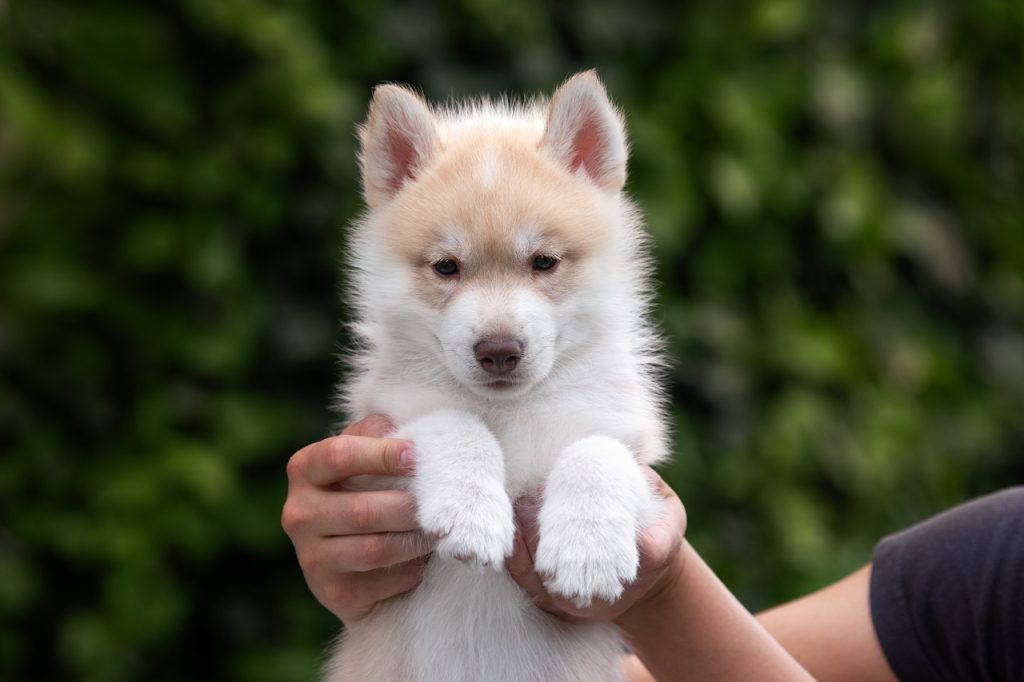
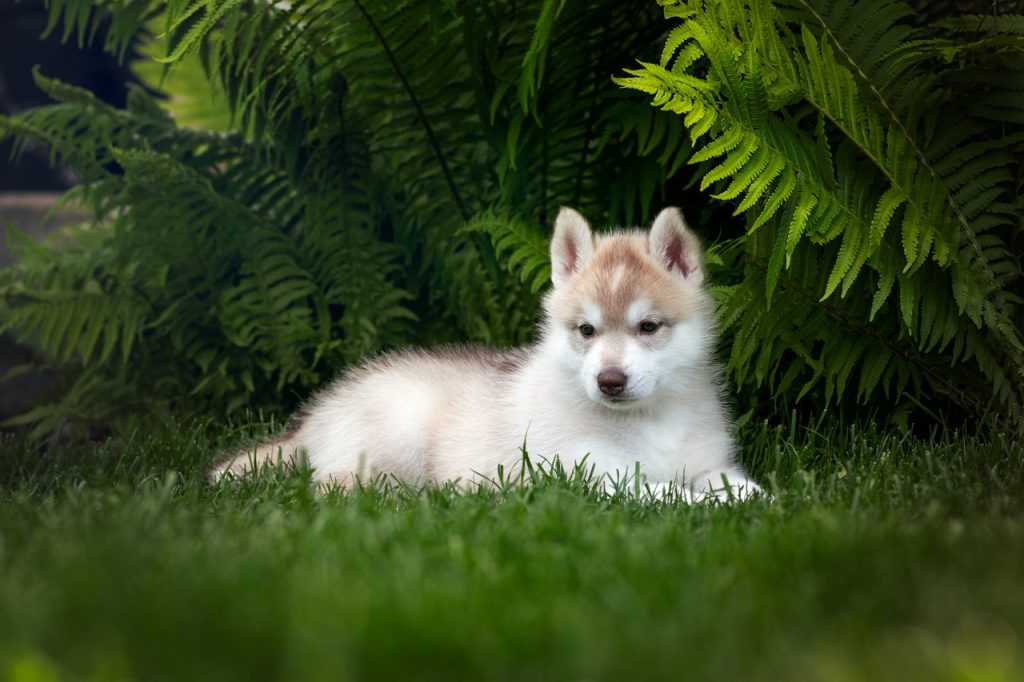
What to look for when choosing a siberian husky puppy
A puppy that is 2–3 months old is not yet an adult dog. Although, generally speaking, a puppy of this age may vaguely resemble its future adult self. Therefore, always check out the parents, grandparents, and great-grandparents (in the photos).
Overall condition: The puppy should look like a healthy, well-loved, happy “baby.” Its ribs should not be visible. The puppy should look well-fed and well-groomed.
Gait: The puppy should move freely and effortlessly. If the puppy limps or hobbles, this is a reason to ask the breeder questions.
Coat: still puppy-like but double-layered, without gaps, it is dense. The undercoat should already be present, and the guard coat may be starting to grow. However, if it’s a hot summer, the coat won’t be as dense.
Eyes and Ears: The eyes are clear and free of discharge. Blue eyes are not a key indicator of breed purity in Huskies. The ears are clean and erect (they may not yet be erect in puppies, which is normal up to 2–3 months of age), but they may appear too large because they grow quickly and are among the first body parts to develop, starting at 2 months of age.
Behavior: A healthy Siberian Husky puppy is curious, active, and not too shy. It approachs you, sniffs you, seeks interaction, and takes the food you offer. If the puppy hides in a corner and trembles, that’s a bad sign.
Documents: FCI puppy pedigree, parents’ pedigrees, parents’ title certificates, veterinary passport, microchip, and age-appropriate vaccinations.
If a breeder says “we’ll handle the paperwork later” or “it’s cheaper without papers,” or seems confused about the paperwork – that’s not a good sign
A good breeder will tell you about each puppy, its temperament, and its potential. They’ll tell you about its parents and their achievements. They’ll answer your tough questions. They’ll help you choose a puppy. Not all puppies in a litter may be available for sale, and some may be available under a co-ownership basis.
standards
Here are some links to official resources on the Siberian Husky standard.
Our kennel is affiliated with the FCI, so we follow its standards. The American Kennel Club of Siberian Husky standard is illustrated and is essentially the same as the FCI’s