+380-63-359-74-69 79000 LVIV, UKRAINE


The History of the Siberian Husky breed
Home » Breed history
From Chukotka to Alaska - How It All Began
More than 3,000 years ago, in the far northeast of the Chukchi Peninsula, the Chukchi people bred a breed of dogs that became essential to their survival. These dogs played a vital role in the economic, spiritual, and political spheres of Chukchi life. These were partner dogs. They pulled sleds loaded with goods over long distances, helped hunters and fishermen reach the coast, and at night slept in the yaranga alongside the children, warming them with their body heat.
The Chukchi selected dogs based on the following criteria: endurance, temperament, low maintenance, intelligence, and the ability to survive in the Arctic climate. Dogs that did not meet these requirements were neutered, and only the best were allowed to breed. At the same time, the dogs lived in the family alongside women, the elderly, and children. Aggressive dogs had no place in this system. Thus, over the millennia, a breed emerged that is both incredibly hardy and friendly toward humans.
Chukotka’s isolation has kept the breed pure for centuries. There has been no interbreeding with other dogs. Only rigorous natural and artificial selection. That is why the Siberian Husky still embodies that same ancient type: a working dog, agile, intelligent, independent, and family-oriented
These dogs were first brought to Alaska in the 1900s by William Gusak, a fur trader who purchased them at a fair in Markovo and in settlements along the Anadyr River. The locals quickly recognized the exceptional sled-pulling abilities of these Chukchi dogs.
In 1915, Leonard Seppala—the best musher of his time in Nome—won the “All Alaska Sweepstakes” race, finishing first with a team of dogs imported from Siberia. From that point on, he competed exclusively with huskies. These were short- and medium-distance races in Alaska, Canada, and New England. Wherever he went, he always won. People described him as “the little man with the little dogs.” Eventually, Leonard Seppala and his huskies, led by the team’s lead dog, Togo, became a legend. And Togo can be found in the pedigree of every purebred husky.

Alaska - Serum Run in 1925 year
In January 1925, an epidemic of diphtheria broke out among children in the town of Nome, Alaska. The only available serum was a thousand kilometers away. There were no railroads. Planes couldn’t take off in the freezing cold. There was only one option left: dogs.
20 mushers and over 150 dogs relayed serum from Nenana to Nome across the harsh, icy terrain. Leonard Seppala and his huskies, led by Togo, covered the longest and most dangerous 340-mile stretch in a blizzard at -40 °C. Meanwhile, other teams could barely cover 53 miles. This small, compact, dark-colored 12-year-old dog, with tremendous fortitude, led the team through the fierce blizzard across the ice of the bay Norton Sound, risking falling through the ice. Togo made the decisions himself. And every one turned out to be the right one.
The serum was delivered in 5.5 days, covering 650 miles. The children were saved. The final leg was covered by musher Gunnar Kaasen together with the lead dog, Balto.
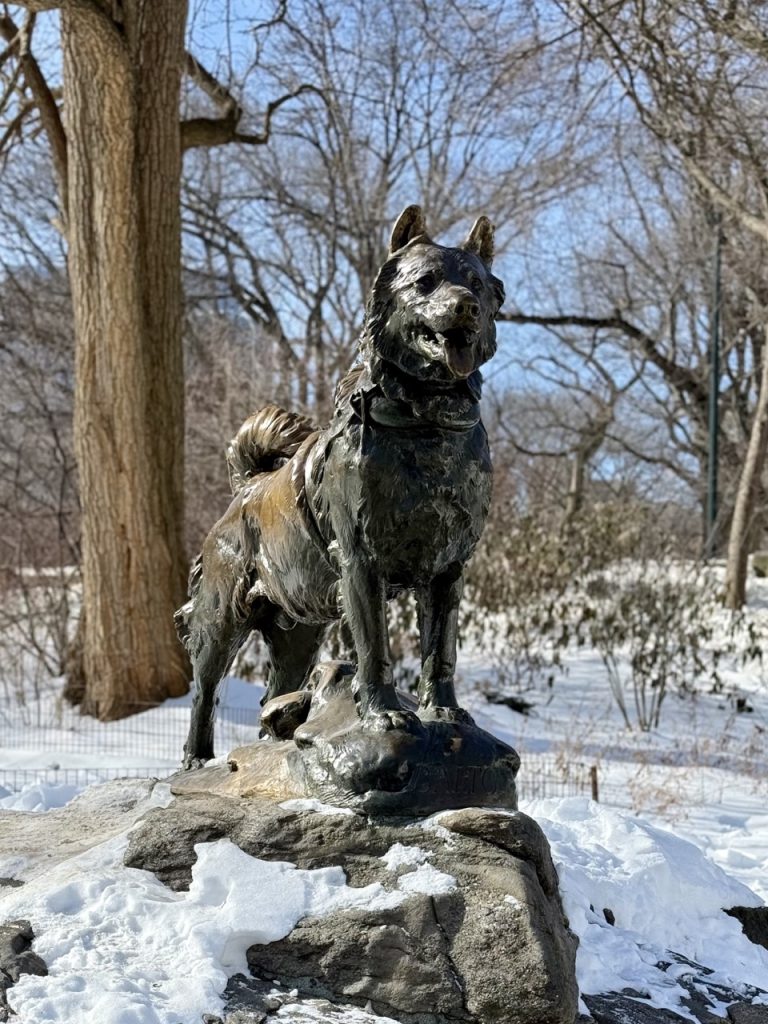
A monument titled “The Spirit of the Northern Sled Dogs” has been erected in New York Central Park, featuring a statue of Balto. But those familiar with the story know that the real hero was Togo.
The 1925 Serum Run made the Siberian Husky famous worldwide as a breed that saved a man’s life thanks to its exceptional qualities: endurance, loyalty, and intelligence.
Following the Serum Run interest in Seppala’s Siberian Huskies surged dramatically. They were particularly highly regarded by their fans in New England. American breeders began focused work on the breed. In 1930, the American Kennel Club (AKC) officially recognized the Siberian Husky as a breed. In 1938, the Siberian Husky Club of America (SHCA) was founded (the first breed club), which still exists today and remains the primary guardian of the breed standard worldwide.
The Fédération Cynologique Internationale (FCI) recognized the breed in 1966 under number 270. The FCI standard is based on the American original because it was in the United States that the Siberian Husky was preserved and developed as a breed after Soviet authorities in Chukotka virtually wiped out the original population, replacing local dogs with larger sled dogs.
Today, the breed standard is uniform worldwide. The AKC and FCI describe the exact same dog: medium-sized, light on its feet, hardy, with a double coat and free, energy-efficient movements. However, two distinct visual types have emerged within the breed: the American show type and the working type. At Hakuna Vota, we work with the American show type, adhering to the standards of both organizations.
FCI STANDARD
AKC STANDARD
Today, Siberian Huskies can be found on every continent even in South Africa. The world has changed, society has changed, and so have its needs. But Siberian husky haven’t lost their purpose; in fact, they’ve found a new one.
Fanciers of this breed around the world strive to preserve the Siberian Husky’s original purpose and pay proper tribute to the reason it was bred by participating in sled dog sports at both the professional and amateur levels. At the same time, they are introducing new activities involving the breed. From dog shows to cani-cross, hiking, and canine therapy
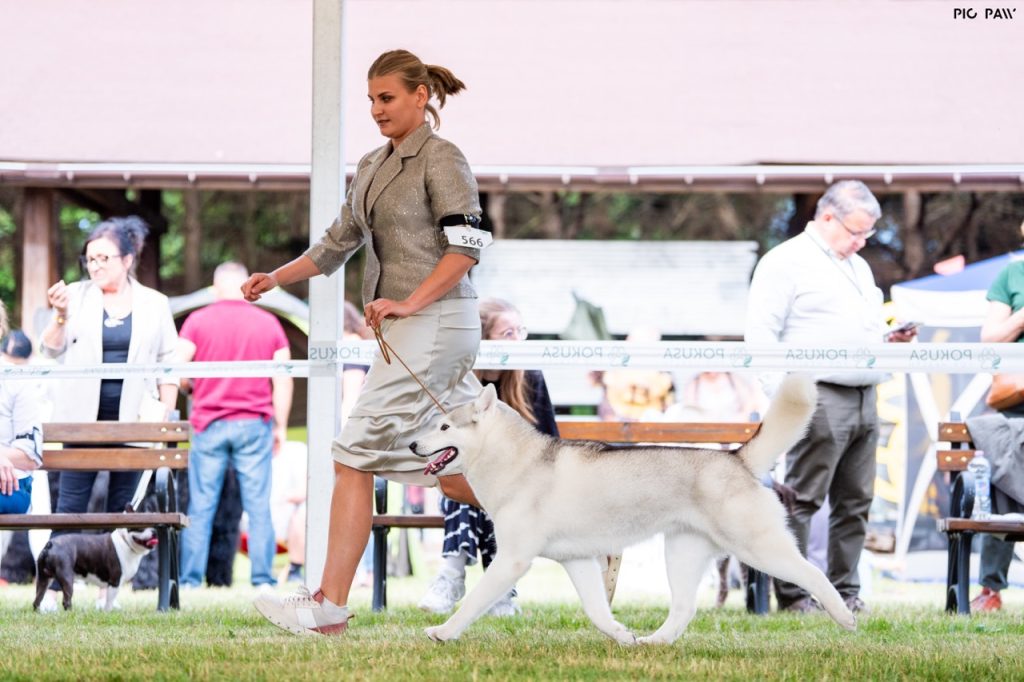
Dog Shows
Siberian husky is a very welcomed breed in the dog show world. They win Best in Shows quite often.
In fact, there are as many as five of the most prestigious dog shows in the world: by Westminster Kennel Club (USA), Crufts by Royal Kennel Club (England), World Dog Show (FCI World), European Dog Show (FCI World), and the Siberian Husky Club of America National Specialty (USA).
Being an exhibitor at a dog show is not as easy task as it seems at first glance. It is a beauty contest among dogs within each breed, where a qualified conformation judge evaluates each exhibitor for the closest match to the breed standard. The winner is the dog that is the best representative of the breed in terms of conformation, physical condition, emotional state, quality and beauty of movements, quality of presentation, and the overall impression of the human-dog team.
And the challenge lies in presenting your purebred Siberian in the best possible way. To do this, you should raise, train, and nurture her. You should help her develop a confident personality, preserve her spirited temperament, and unlock her potential through rigorous, regular trainings.
In reality, dog shows are a fun activity to do with your dog; they’re like a hobby, and a very exciting one at that. It’s a whole world of amazing people for whom their dog is the center of the universe. It’s also a huge, demanding undertaking. But the payoff is incredible. Although there are disappointments, tears, fear, and doubts along the way. Once you try it and achieve success, you’ll want more.
Dog shows really broaden your horizons and are a wonderful opportunity to explore the world alongside your beloved dog
sled dog sports
This is a whole new chapter in the life with siberian husky. And probably the most adrenaline-fueled one. Because it’s kind of like the thrill of skiing, snowboarding, or downhill racing.
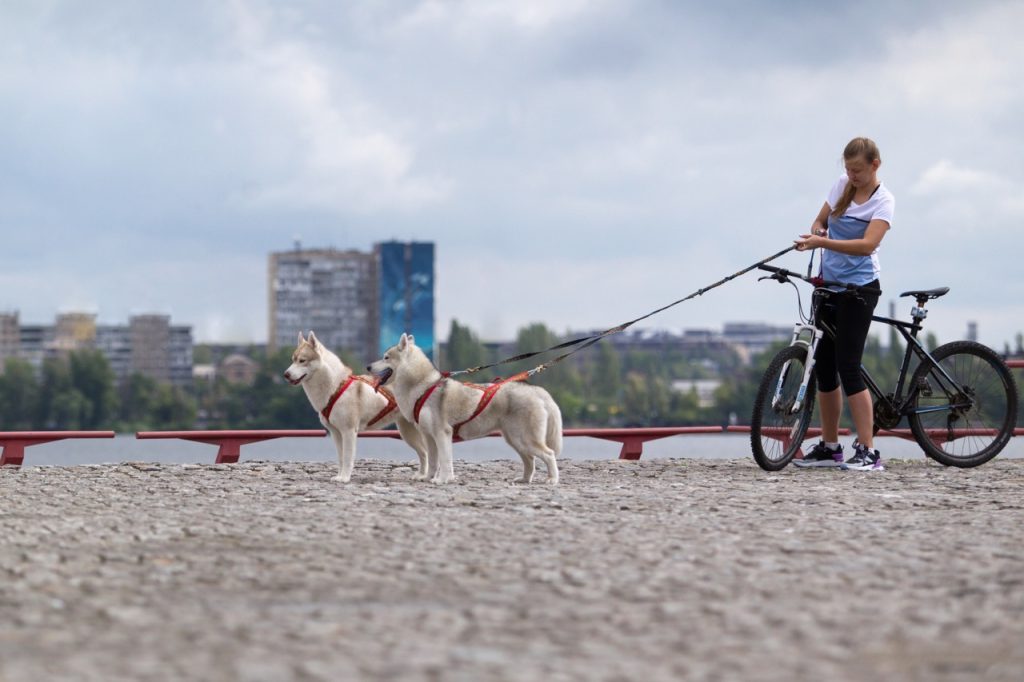
You’ve got a bike at home, along with all the gear you need for bikejoring: a harness, a carabiner, suspension-equipped leashes, a headlamp, and high-tech clothing. And a rush of endorphins from riding through fields, forests, or along the riverbank or seashore. It’s a moment where you’re both fully present, right here and now. You feel a true partnership between dog and human. It’s an unforgettable experience and an incredible sense of fulfillment.
It’s for these feelings that we love Siberian husky.
adventure buddy
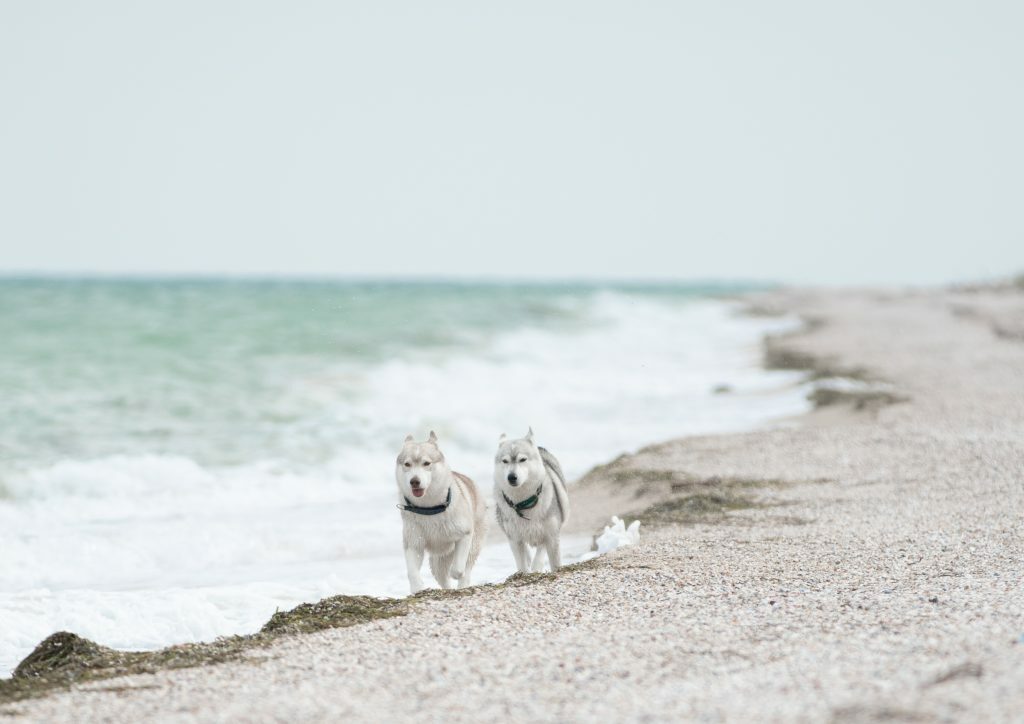
Siberian husky and adventure go hand in hand. Husky makes wonderful companions on mountain hikes and on expeditions to explore any terrain. They’re a great companion on road trips or simply on morning walks along the seashore, or along a river, or in a pine forest, or somewhere in the woods. It’s especially nice to do this in winter, fall, and spring.
In summer, they’re the best companions for lounging on the couch under the air conditioner, or for swimming in a wetsuit, kayak, or rowboat. They fit perfectly into a wilderness getaway: tents, a campfire, and food cooked over a fire in the mountains or by a river or lake.
They don’t really care where your adventures take you, as long as there are adventures, new horizons, and new points on the map.
a victim of immense popularity
The Siberian Husky is one of the most recognizable breeds in the world. With its blue eyes and black-and-white coat, it resembles a wolf and howls rather than barks. And it is precisely this recognizability that has become both a blessing and a curse for the breed.
After the TV series *Game of Thrones*, the popularity of Husky skyrocketed. People bought puppies for their looks, but six months later, they gave them to shelters or abandoned them on the street because they couldn’t handle their temperament. According to statistics, siberian huskies consistently rank among the top breeds in terms of the number of abandonments. This happens because people are drawn to the their striking appearance and the heartwarming stories we see in movies, without giving much thought to the realities of living with one.
The breed fell victim to subtle marketing tactics. Everyone wanted a dog with good looks, so breeders began popping up who bred mixed-breed Huskies; prices dropped, the quality of the breed began to decline, and owners faced an increasing number of problems.
People got Siberian huskies without understanding what it takes to care for them, what is the original purpose of that breed and ended up facing challenges they hadn’t anticipated.
The more problems husky owners encountered, the more negative reviews about these dogs appeared online.
