+380-63-359-74-69 79000 LVIV, UKRAINE


Siberian husky is the breed that saved children from a deadly disease
Home » About the breed
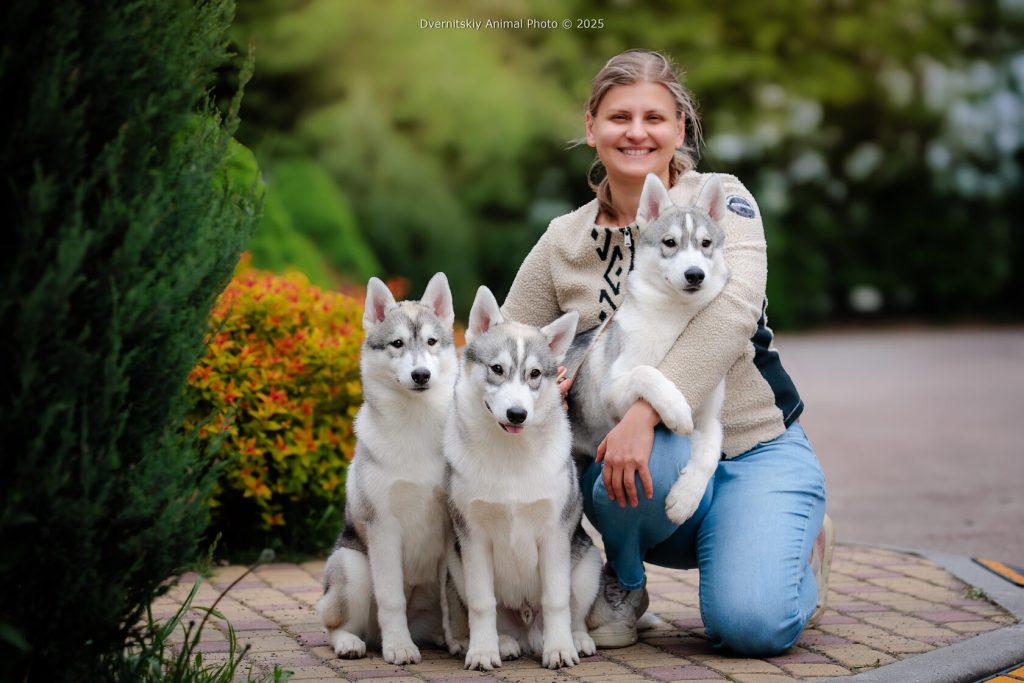
The Siberian Husky is one of the oldest and most noble dog breeds of primitive origin. They are not the ideal pet for everyone or every family. Their origins in the harsh north, where they were bred to be sled dogs, endow Huskies with great physical strength and endurance, the ability to regulate their metabolism, a tendency to rely less on humans and more on teamwork, a certain degree of independence, the ability to make decisions on their own, while also being a family dog, and, of course, having a very luxurious, thick coat.
On the other hand, the Siberian Husky is extremely intelligent (some say sometimes even too smart for its own good), cheerful, and charming. It loves children and treats them gently and tenderly (although puppies and toddlers require close adult supervision, as neither party is aware of the other’s fragility). The Husky is clean and odorless, making it an excellent choice as a companion for those prone to dog allergies. And despite its independence and occasional stubbornness, it is an extremely affectionate animal that, even as an adult, often seems to believe it was born to be a lap dog. Those who love Siberian Huskies typically appreciate its wolf-like natural beauty and athleticism—in short, the Husky’s personality, minimal grooming needs, and strong family instinct. In a home with only one dog, it can sometimes become restless, bored, and lonely, so it will need to spend most of its time with the family. Although Siberian Huskies rarely bark, they may still howl (call out) when they’re lonely; therefore, solitary Siberian Huskies can be quite noisy. That’s why experienced Husky owners keep 2–3 Huskies. They really need a family—whether human or canine—and if they don’t have one, they feel unhappy. And if they’re unhappy, they start making decisions on their own, such as running away in search of their family.
The main characteristics of Huskies are that they love to dig holes and hunt for themselves. Huskies are like that—if they hunt, it’s exclusively for themselves. This genetic tendency dates back to ancient times, when the Chukchi would let their dogs roam freely in the summer, and the dogs had to fend for themselves as best they could.
Today, the Husky is a unique companion for people with an active lifestyle and a strong inner core, who themselves value family life and are hardworking, deep-thinking individuals. It is quite easy to interact with a well-bred, well-trained Husky, despite their breed-specific traits.
Tetiana's experience
I grew up in a family that always valued purebred dogs. In our case, they were Kurzhaars. We took them to field trials and dog shows to get evaluations for breeding. I grew up understanding that a purebred dog always has a purpose.
But why did I choose Siberian husky? Because one winter, my dad decided to cheer me up and harnessed our two Kurzhaars to a sled, attaching it to the sled. He told me to get in and hold on tight. I was about 7 years old. He shouted to the dogs, “Go!” They shot off from a standing start, yanked the sled out from under me, and raced off into the distance. I thought it was really funny at the time, and I realized there was something special about it.
Ever since then, that memory has stayed with me. And when I finally realized as an adult that I was ready for a dog, I said without hesitation that it would have to be a Husky. I wasn’t scared off by any of the horror stories about them online. On the contrary, I even felt a sense of challenge and excitement. The main thing was to find breeders of truly purebred Huskies and not end up with a mix of Husky crossbreeds.
I was lucky enough to find a good Husky breeder with an excellent socialization program, an approach to the breed that appealed to me, and a puppy with excellent pedigree.
They showed us all the puppy’s relatives from both lines, listed all the titles, and answered our questions. Meanwhile, our future puppy (who was already 3 months old) brought my boot over to me and started playing with it in a showy way. That melted our hearts. Although, we would have chosen her even without that little incident.
That’s how we got Haka, and two months later we realized we needed a second husky. As luck would have it, our breeder decided to sell the very puppy they had been keeping for themselves—and I really liked her. They put her up for sale when she was six months old. That was our Yuna. And we snapped her up right away. It was a great decision.
And so began the new life I had always wanted. In addition to the excitement and the new addition of a dog, we started training in dog sledding, and then the world of dog shows opened up to us—a world that still holds us in its grip. We’ve traveled all over Ukraine and discovered the joys of road trips to Europe.
My professional growth began in the breed, as a breeder and future expert.
In our experience, it’s surprisingly challenging to have just one husky at first, but the more experienced you are, the easier it is to have a whole pack of huskies.